
Email Us
contact@adpressureclean.com
Mon - Sun: 8am - 8pm
Quotes Always Available!
(813) 822-5326
Give us a ring!
Have you ever noticed dark black lines or curved marks on your concrete driveway where a vehicle turns, stops, or parks?
Those marks may not be ordinary dirt.
Hot tires can leave rubber residue on concrete, particularly when a vehicle makes a sharp turn, brakes heavily, or moves across a warm driveway surface. The result can be a dark streak or scuff that remains visible even after the vehicle is gone.
For homeowners in Tampa, FL (33647), these marks can become more noticeable because concrete surfaces are regularly exposed to Florida’s heat and sunlight.
So what causes tire marks, and can they be removed without damaging the driveway?
What Causes Black Tire Marks on Concrete?
Tires contain rubber compounds and other materials designed to provide traction and durability.
When tires become warm, some of the material on the tire can transfer onto a concrete surface. Turning the steering wheel while the vehicle is stationary or moving slowly can create additional friction between the tire and driveway.
This can leave behind a dark curved mark.
The marks are especially common around:
Garage entrances
Driveway turning areas
Parking spaces
Areas where vehicles make tight turns
Sections where vehicles regularly stop and start
A driveway does not have to be old or heavily stained for tire marks to appear.
Why Are Tire Marks More Noticeable on Concrete?
Concrete is porous.
Unlike a smooth painted surface, its texture contains small pores and variations that can hold onto material transferred from tires.
A fresh rubber mark may initially sit mostly on the surface. Over time, repeated traffic, heat, sunlight, and weather exposure can make the discoloration more difficult to remove.
This is one reason a tire mark that looked minor when it first appeared may become more noticeable later.
Why Does Tampa’s Heat Matter?
Tampa driveways spend much of the year exposed to strong sunlight and warm temperatures.
That means the concrete itself can become hot during the day, while tires also heat up through normal driving.
When a warm tire makes a sharp turn against a warm concrete surface, rubber transfer can become more noticeable.
This does not mean every black mark on a Tampa driveway is caused by tires.
Oil, grease, dirt, asphalt residue, and other substances can create similar-looking discoloration.
Identifying the source before choosing a cleaning method is important.
Are Tire Marks the Same as Oil Stains?
No.
The two can sometimes look similar from a distance, but they are different types of surface contamination.
Tire marks
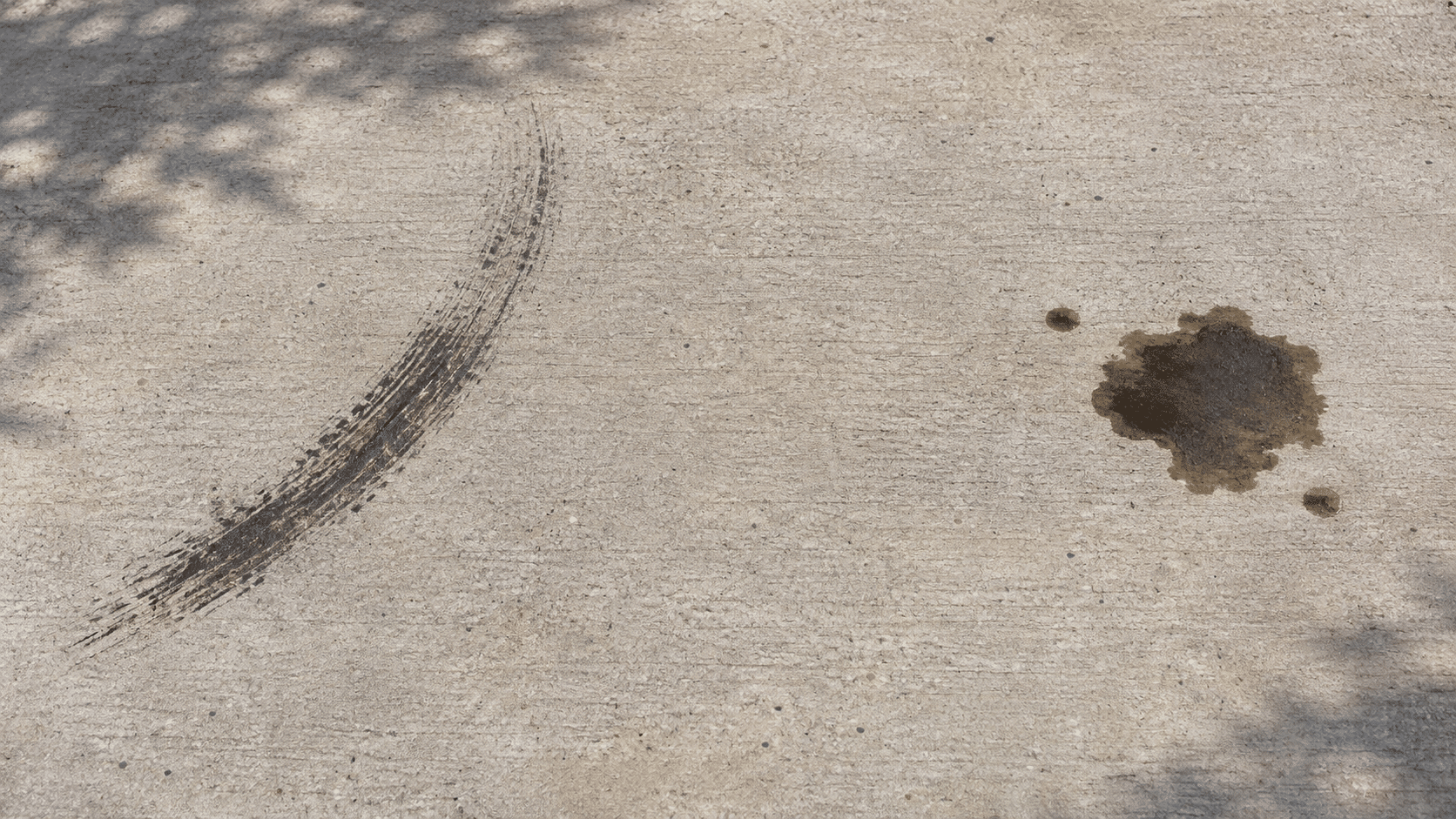
Tire marks often appear as:
Curved black lines
Dark arcs
Straight skid-like marks
Scuff marks near turning areas
Repeated marks in parking locations
Oil or grease stains
Oil-related staining is more likely to appear as:
Irregular spots
Dark patches
Drips beneath vehicles
Areas surrounding an engine or mechanical leak
Of course, a driveway can have both.
A vehicle that regularly parks in the same location may leave tire marks while also producing oil or other automotive residue.
Can Pressure Washing Remove Tire Marks?
It can help, but pressure alone is not always enough.
Light surface marks may respond to normal driveway cleaning. More established rubber residue can require additional cleaning treatment before or during pressure washing.
The important point is that more pressure does not automatically mean better stain removal.
Using excessive pressure can affect the appearance of concrete without addressing the material causing the mark.
The cleaning approach should be based on the condition of the concrete and the type of residue present.
Why You Shouldn’t Immediately Use the Strongest Pressure
A stubborn black mark can make homeowners want to increase the pressure until it disappears.
That can be risky.
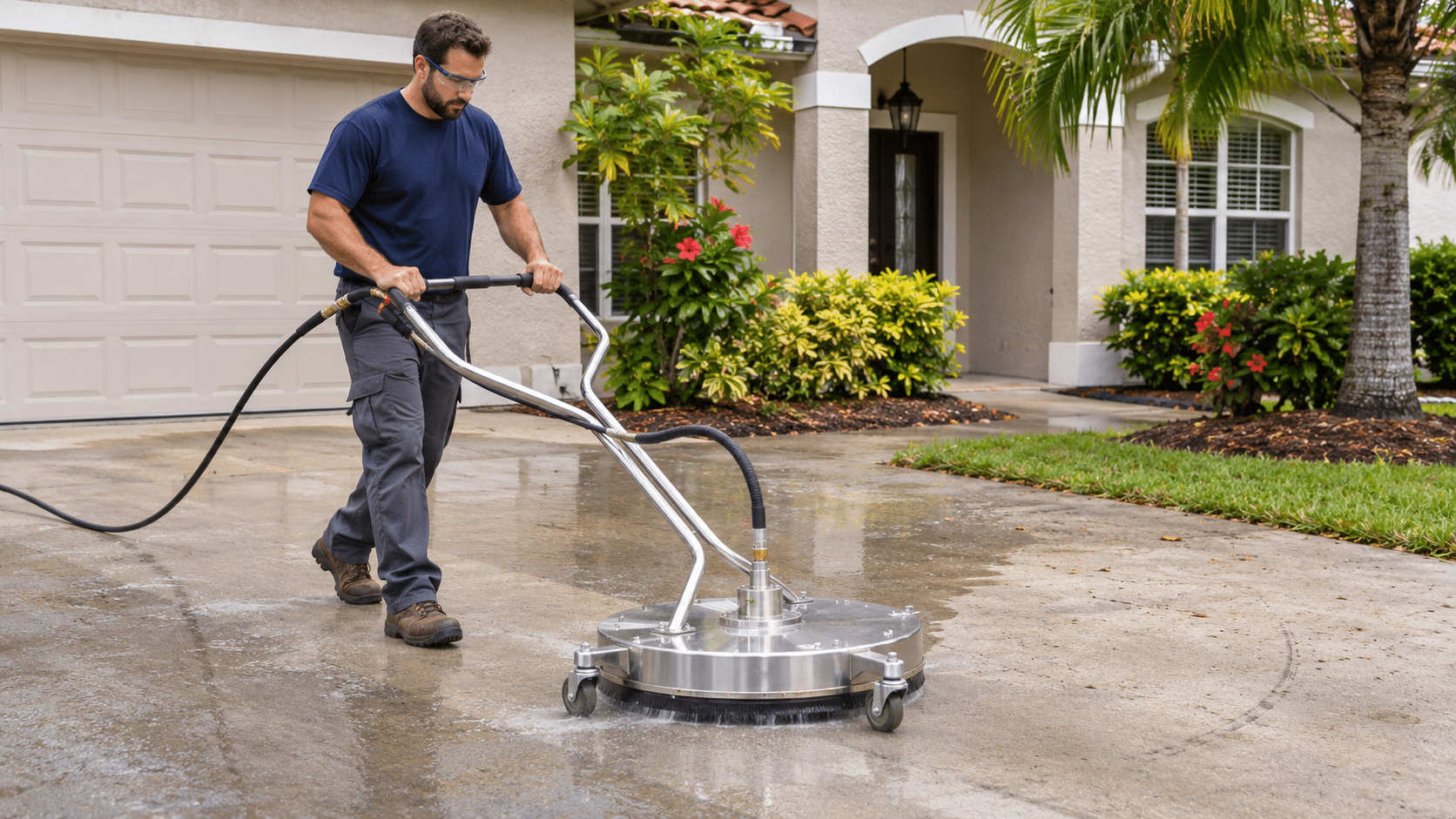
Concrete can be etched or marked by improper pressure washing, particularly when the equipment, nozzle, distance, or technique is not appropriate for the surface.
A driveway should be cleaned with enough pressure to remove the unwanted material while minimizing unnecessary impact on the concrete.
The goal is controlled cleaning, not maximum pressure.
Can Older Tire Marks Still Be Removed?
Possibly.
Fresh rubber transfer is generally easier to address than marks that have remained on the driveway through months or years of outdoor exposure.
However, the age of a stain is only one factor.
The condition and porosity of the concrete, whether the surface has been sealed, how heavily the area is used, and what caused the mark can all affect the cleaning process.
Some marks may improve significantly with cleaning, while others may require additional treatment or may not disappear completely.
That is why it is better to evaluate the actual surface rather than promise that every tire mark can be completely removed.
What If the Concrete Is Sealed?
Sealed concrete requires additional consideration.
A tire mark may be sitting on top of the sealer rather than directly in the concrete.
In that situation, aggressive cleaning can potentially affect the coating itself.
Before using a strong cleaner or high-pressure equipment, homeowners should determine whether the driveway is bare concrete, sealed concrete, or has another type of coating.
A cleaning method that works on unsealed concrete may not be appropriate for a coated surface.
What About Tire Marks on Pavers?
Pavers can also develop tire-related discoloration, particularly on driveways and parking areas.
However, pavers are different from a single concrete slab.
Individual pavers have joints between them, and those joints may contain sand or other joint material.
Cleaning should therefore take the condition of the joints into account.
If the pavers are already showing missing sand, movement, or other issues, aggressive cleaning may not be the appropriate first step.
The surface should be evaluated before cleaning and sealing are performed together.
Where Are Tire Marks Most Likely to Appear?
Take a look at the areas where vehicles regularly change direction.
You may find black marks:
Near the garage
Vehicles often turn as they enter or leave the garage, creating repeated tire contact in the same area.
At the end of a driveway
Tight turns near the street can create curved marks on the concrete.
In parking areas
A vehicle that repeatedly parks in the same location may leave visible marks over time.
Around sharp turns
The more a tire twists against the surface, the greater the chance of leaving a visible rubber scuff.
Near frequently used gates
Driveways near gates or narrow access points may require more turning and maneuvering.
How Can Homeowners Reduce New Tire Marks?
You cannot always prevent tire marks completely, but a few habits may help reduce them.
Avoid making sharp stationary turns whenever possible.
If you need to reposition a vehicle, allowing it to roll slightly while turning can reduce the amount of twisting against the concrete.
Keeping the driveway reasonably clean can also make new marks easier to identify before they become heavily established.
If the driveway has a protective coating, use cleaning products and maintenance methods appropriate for that particular surface.
What If a Black Mark Doesn’t Look Like a Tire Mark?
Do not assume every dark line is rubber.
A driveway can develop different types of discoloration from:
Oil
Grease
Rust
Organic material
Dirt
Asphalt residue
Irrigation-related deposits
Previous cleaning
Surface wear
Some stains can look very similar even though their causes are completely different.
For example, ADPC’s existing guidance discusses several types of driveway and sidewalk buildup and notes that different surfaces and contaminants may require different cleaning approaches.
If you are unsure what caused a stain, identifying the source before applying a cleaning product is a safer approach.
When Should You Have Tire Marks Professionally Cleaned?
Professional driveway cleaning may be worth considering when:
Tire marks cover a large portion of the driveway
The marks have been present for a long time
Previous DIY cleaning did not remove them
The driveway is sealed
You are seeing several different types of stains
You are unsure whether the discoloration is actually from tires
You want the entire driveway cleaned rather than treating individual marks
A professional can evaluate the surface and determine whether standard pressure washing or a more targeted cleaning approach is appropriate.
Concrete Driveway Cleaning in Tampa, FL (33647)
Your driveway deals with more than just vehicle traffic.
Tampa homeowners also have to contend with rain, heat, sunlight, dirt, landscaping, organic material, and everyday outdoor exposure.
When dark tire marks begin appearing, they can make an otherwise maintained driveway look uneven.
American Dream Pressure Clean provides driveway and exterior surface cleaning throughout Tampa, New Tampa 33647, Wesley Chapel, Lutz, Land O’ Lakes, Brandon, Apollo Beach, St. Petersburg, and surrounding Tampa Bay communities.
Our services include driveway cleaning, sidewalk and walkway cleaning, paver cleaning and sealing, pool deck cleaning, house washing, roof washing, gutter cleaning, fence cleaning, and other exterior cleaning services.
Final Thoughts
Black tire marks on concrete are not necessarily a sign that your driveway is permanently damaged.
They can develop when warm tires transfer rubber material onto the surface, particularly in areas where vehicles regularly turn, stop, or maneuver.
Fresh marks may be easier to address than older ones, but the appropriate cleaning method depends on the condition of the concrete and what is actually causing the discoloration.
If your Tampa driveway has dark tire marks that are becoming difficult to remove, identifying the type of stain first can help determine the right cleaning approach without unnecessarily using excessive pressure.