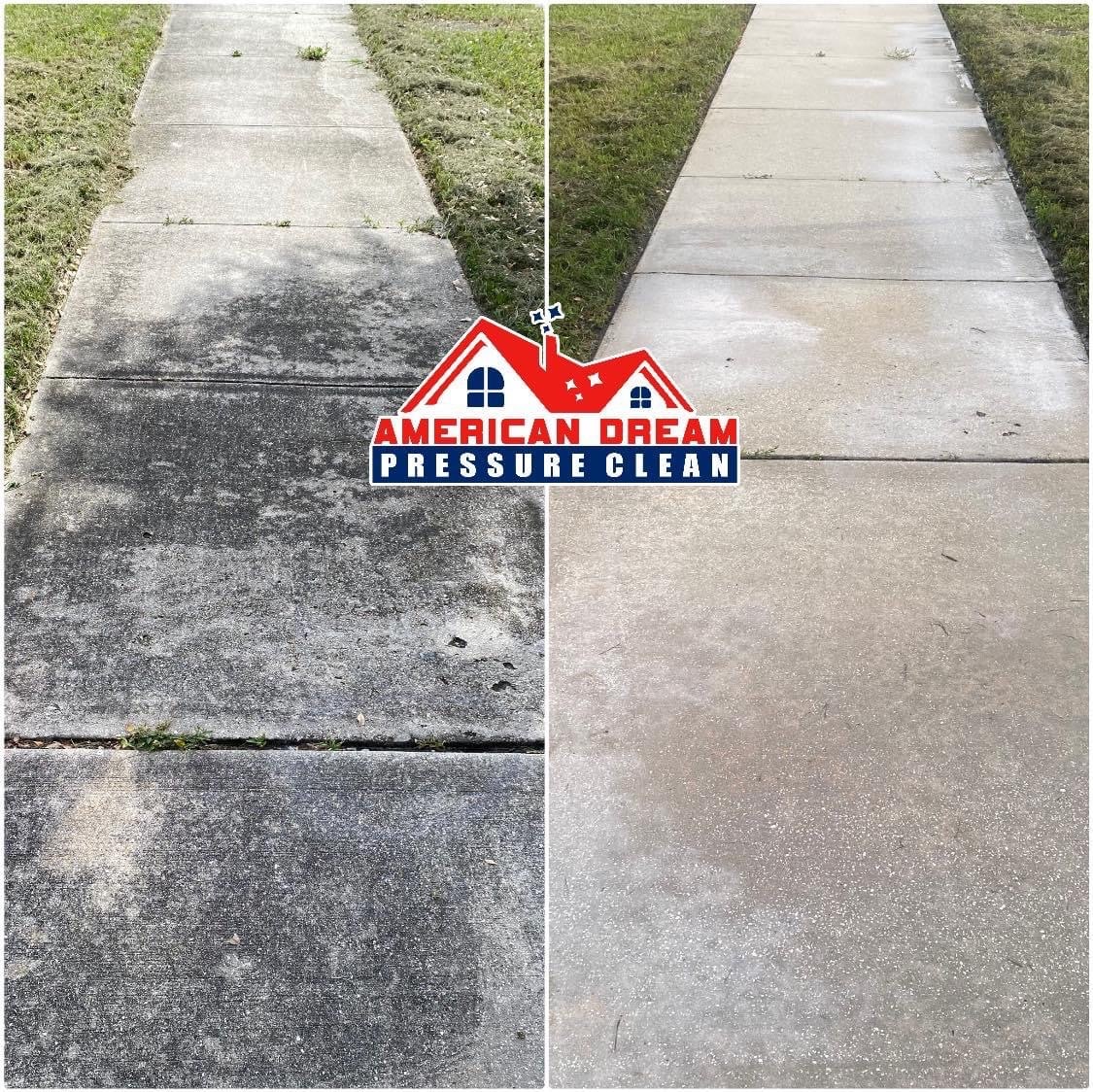
Concrete is porous, which means it can absorb moisture and contaminants. When iron comes into contact with moisture and oxidizes, it can leave behind the orange or reddish discoloration commonly recognized as a rust stain.
Some of the most common sources around Tampa homes include:
IRRIGATION WATER
One of the common causes of recurring rust-colored stains is irrigation water containing iron or other minerals.
When sprinkler water repeatedly lands on a driveway, sidewalk, pool deck, or other concrete surface, mineral deposits can accumulate over time. A stain that appears in a spray or fan-shaped pattern near a sprinkler head may point toward irrigation as the source.
If the source of the iron is not addressed, the staining may return even after the concrete has been cleaned.
FERTILIZER
Some lawn fertilizers contain iron. If fertilizer granules land on concrete and become wet, they can leave small orange or brown marks.
These stains may appear as scattered spots rather than one large continuous area. They can become more noticeable when the fertilizer is exposed to moisture from irrigation or rain.
RUSTING METAL FURNITURE OR EQUIPMENT
Metal patio furniture, planters, grills, tools, gates, fixtures, and other outdoor equipment can leave rust marks where they sit on concrete.
For example, a rusty metal table leg may create a circular stain, while a planter or piece of equipment can leave a distinct outline.
CORROSION AROUND THE CONCRETE
In some cases, discoloration can be associated with metal components within or around the concrete, such as reinforcing steel. If the rust appears to be coming from a crack, damaged area, or specific point in the slab, cleaning the surface alone may not address the underlying source.
This type of situation may require further evaluation rather than simply applying a stronger cleaning product.
HOW CAN YOU TELL IF A CONCRETE STAIN IS RUST?
Rust stains commonly appear orange, reddish-brown, or brown. However, not every orange or brown stain on concrete is necessarily rust.
The location and pattern can provide useful clues.
For example:
• Fan-shaped or streaked staining near sprinklers may be related to irrigation water.
• Small orange spots may be associated with fertilizer containing iron.
• Circular or defined marks beneath metal objects may come from rusting furniture or equipment.
• Staining around cracks or damaged concrete may indicate a source within or beneath the surface.
• General green, black, or slimy buildup is more commonly associated with organic growth rather than rust.
When the source is unclear, it is better to identify the type of stain before choosing a treatment.
WHY PRESSURE WASHING ALONE MAY NOT REMOVE RUST
This is an important distinction for homeowners.
Pressure washing is effective for removing many types of surface dirt, grime, algae, and other buildup. Rust, however, is a different type of stain.
Iron-related discoloration can bond with or penetrate the porous surface of concrete. Increasing the pressure does not necessarily make the stain disappear. In fact, using excessive pressure in an attempt to remove a stubborn stain can potentially damage or etch the concrete.
That is why rust stain removal generally involves a surface-appropriate specialty treatment rather than relying on pressure alone.
HOW TO REMOVE RUST STAINS FROM CONCRETE
The appropriate process depends on the concrete surface, the source of the stain, how long it has been present, and whether the concrete has previously been sealed or treated.
A general rust-removal process may include the following:
STEP 1: IDENTIFY THE SOURCE
Before treating the stain, look around the affected area.
Check for:
• Sprinkler heads
• Irrigation spray patterns
• Metal furniture
• Planters
• Grills or outdoor equipment
• Fertilizer residue
• Rusting fixtures
• Cracks or damaged areas
Removing or correcting the source can help prevent the stain from returning.
STEP 2: CLEAN THE SURROUNDING SURFACE
Loose dirt, leaves, and other surface debris should be removed first. This allows the affected area to be properly evaluated and prevents ordinary surface grime from interfering with the treatment.
STEP 3: CHOOSE A CONCRETE-SAFE RUST TREATMENT
Rust requires a product specifically designed to address iron staining. The treatment should be compatible with the particular surface being cleaned.
This is especially important when working around decorative concrete, sealed surfaces, pavers, pool areas, landscaping, or other materials that may react differently to cleaning chemicals.
STEP 4: TREAT THE STAINED AREA
A suitable rust treatment is applied according to the product’s instructions and the condition of the stain.
Some stains respond relatively quickly, while older or deeper discoloration may require additional treatment.
The goal is not simply to increase pressure. The treatment needs to address the iron-related discoloration itself.
STEP 5: RINSE AND EVALUATE
After treatment, the surface is rinsed and evaluated.
Some stains may improve substantially after one treatment, while older or deeply embedded stains may require additional work. Results can also vary depending on whether the stain is coming from the surface or from an ongoing source.
CAN YOU REMOVE RUST STAINS YOURSELF?
Small, fresh stains may sometimes be treated by homeowners using a product specifically labeled for rust removal on concrete.
However, caution is important.
Not every rust remover is appropriate for every surface. Using the wrong chemical, concentration, or application method can discolor or damage concrete and surrounding materials. Always follow the product manufacturer’s instructions and test a small inconspicuous area when recommended.
Homeowners should also avoid mixing cleaning chemicals. Strong acids or other inappropriate products can create unnecessary safety risks and may damage the concrete.
For large areas, stubborn stains, or stains near landscaping and other sensitive surfaces, professional treatment can be a safer option.